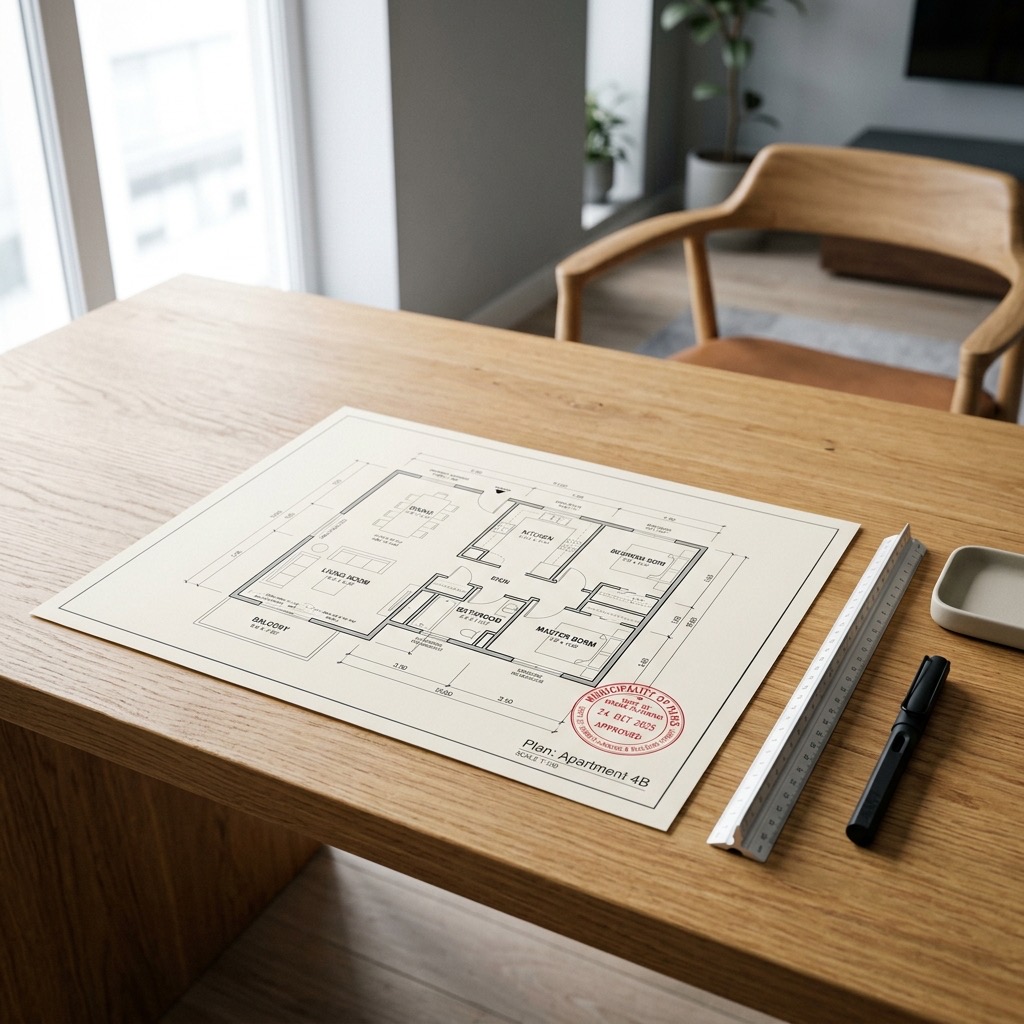
One of the biggest mistakes when undertaking a renovation in the Catalan capital is underestimating the strict regulations of the Barcelona City Council (Ajuntament de Barcelona). Starting work without the proper permit can lead to immediate stoppage of the project by the Guardia Urbana, heavy financial fines, and serious conflicts with the homeowners' association.
As a high-end renovation company in Barcelona with decades of experience, at Nosolo Design we always handle this legal section, but we believe it is vital for the owner to understand the differences between permit types.
The 3 Types of Permits in Barcelona
1. Assabentat d'obres (Prior Communication)
This is the simplest and fastest procedure. It applies to minor works that do not alter the layout, the structure, or the exterior appearance of the building. The approval is instant online and it is free of charge.
- Painting and wallpapering.
- Replacing flooring or tiling in kitchens and bathrooms.
- Repairing installations (water, electricity, gas) as long as their general layout is not changed.
2. Comunicat d'obres (Prior Notification)
This is the primary permit for any standard comprehensive renovation. It is required when modifying the interior layout (knocking down partition walls) or completely replacing plumbing or electrical installations. Depending on the complexity, it requires a plan or a technical project signed by a licensed architect or technical architect. It requires paying municipal taxes (ICIO).
3. Llicència d'obres (Major Works License)
This is the most complex, expensive, and slowest permit to obtain (taking anywhere from 1 to 6 months). It is mandatory when:
- Structural elements are modified (load-bearing walls, pillars, slabs).
- The facade is altered (changing windows in protected areas, extending balconies).
- Working on buildings listed as historic heritage (highly common in L'Eixample or Ciutat Vella).
- Performing a change of use (from commercial premises to residential housing).
The Invisible Cost: Rubble Containers
In addition to the building permit itself, placing a rubble bag or container on the public street requires paying for the Public Space Occupation Permit. Its cost depends on the square meters occupied and the days it remains on the street. A container without a permit will be removed by the City Council, and the fine will be sent to the owner of the works.
Delegate bureaucracy to professionals
Our technical office takes care of drafting projects, certifying plans with the architects' association, and handling all Barcelona City Council licenses online.
Contact Nosolo Design